
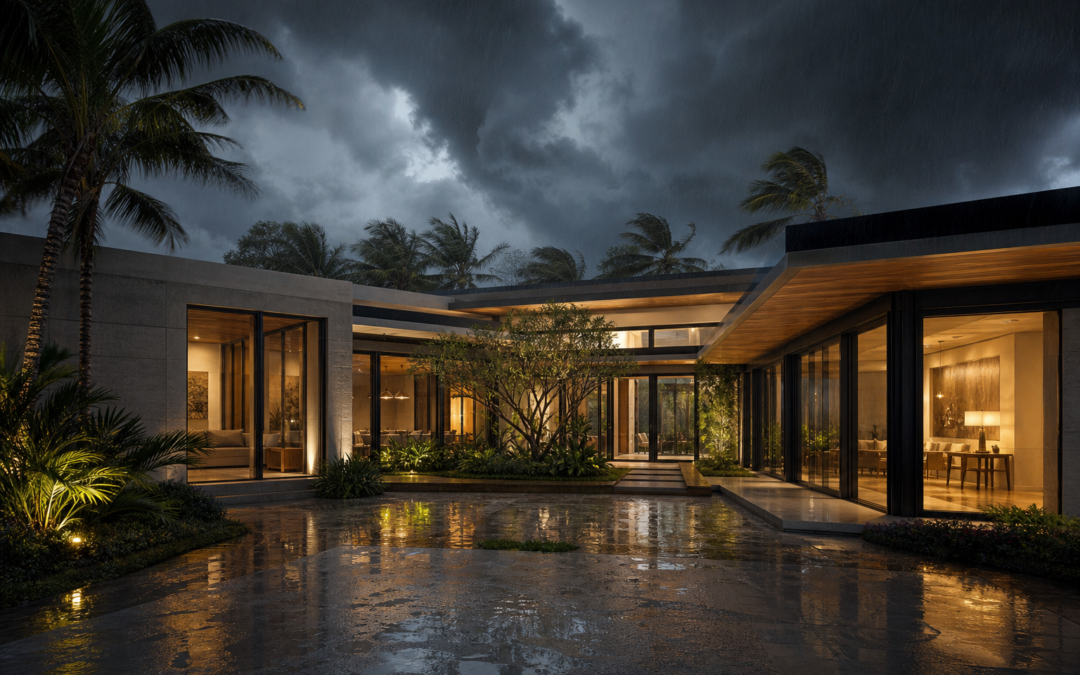
Building a hurricane-resistant custom home in Sarasota, Florida, isn’t just about meeting basic building codes — it’s about going beyond them. If you’re considering building or investing here, understanding these structural design choices can make a real difference in safety and long-term value.
How Structural Design Choices Exceed Standard Building Codes
Start with reinforced concrete walls. Compared to traditional wood-frame construction, reinforced concrete offers much stronger wind resistance. A study by the National Concrete Masonry Association found that concrete walls can withstand winds over 200 mph — crucial in Florida, where hurricanes like Irma remind us of nature’s power.
Roof design matters just as much. A hip roof, which slopes on all sides, provides better wind resistance than gable roofs. FEMA highlights that hip roofs are less likely to lift in strong winds, reducing the risk of structural damage.
Beyond roof shape, securing the roof-to-wall connection is critical. Metal straps and anchors — known as hurricane ties — keep the roof attached to the walls even in extreme winds. Research by the Insurance Institute for Business & Home Safety shows that homes with reinforced roof-to-wall connections experienced far less damage during hurricanes.
Window and door protection is equally important. Impact-resistant windows and doors resist windborne debris through layers of shatter-resistant film sandwiched between glass panels. They protect against flying objects and minimize the pressure changes that can cause roof or wall failure.
While standard codes require some degree of water intrusion protection, going further means installing waterproof membranes beneath your roofing material. Think of them as a second skin — even if shingles are lost in a storm, that membrane keeps water out. These barriers reduce the risk of leaks and water damage significantly.
Finally, site selection plays an often-overlooked role. Elevated sites reduce flood risk, and building on higher ground or with an elevated foundation lessens the chance of floodwater damage. The U.S. Department of Housing and Urban Development recommends this as a key preventative strategy in flood-prone areas.
Every one of these choices compounds. Together, they don’t just meet the minimum — they give you a home built to last through whatever Florida throws at it.
Why Engineering and Design Teams Collaborate From Day One
In Sarasota, the success of building custom homes starts with one principle: get everyone in the room early. Bringing engineering and design teams together from day one is what separates a well-built home from an exceptional one.
Picture a house that doesn’t simply sit on a lot, but feels genuinely connected to its surroundings. That kind of integration doesn’t happen by accident. When architects and engineers work together from the design phase, potential mismatches between structural plans and aesthetic goals get resolved before they become costly revisions. Courtyard Modern is built on exactly these synergies — ensuring every modern, coastal, Mediterranean, or courtyard-style home is both structurally sound and visually compelling.
Sustainable features are a clear example of this approach in action. Sarasota’s coastal climate demands energy efficiency, and early collaboration allows teams to weave in solar panels, energy-efficient HVAC systems, and intelligent water management without retrofitting them in later. A study from the National Institute of Standards and Technology confirms that incorporating sustainability from the beginning can lead to a 15% reduction in future retrofitting costs — a meaningful advantage for investors focused on long-term returns.
Practicality and aesthetic ambition can clash in home construction. By uniting engineers and designers from the start, features like open-concept living spaces or floor-to-ceiling windows can be designed in ways that respect structural integrity. Take the courtyard spaces that many Sarasota residents love — they offer a personal sanctuary within a modern aesthetic while also enhancing natural airflow. Collaborating engineers ensure those spaces don’t compromise the home’s stability or energy performance.
Building Information Modeling (BIM) has also transformed how Courtyard Modern projects come together. This software enables real-time, 3D visualization of plans so every team member stays aligned. According to McGraw-Hill Construction research, early use of BIM lowers total project costs by nearly 22% due to reduced errors and omissions.
Early collaboration turns custom home building into something closer to an art form. These aren’t just structures — they’re cohesive expressions of architectural excellence, shaped by continuous dialogue and a shared vision, setting the standard for luxury living along Sarasota’s coast.
The Testing and Inspection Process That Ensures Every Home Is Storm-Ready
In Sarasota, beautiful coastal views come with a guarantee: storm season is coming. The testing and inspection process behind every home we build is what ensures your property is ready when it does.
Every serious homebuilder implements rigorous checks at each stage to certify that a structure meets — and surpasses — all safety standards. At Courtyard Modern, that starts before a single wall goes up.
Initial planning includes a comprehensive assessment of local wind and water damage patterns, so designs respond directly to the climate’s demands. Engineers examine soil and site conditions early to design appropriate foundations. In flood-prone areas of Sarasota, that often means elevated or reinforced foundations built to resist the lateral forces of storm surge. According to the American Society of Civil Engineers, robust foundation design is one of the most critical factors in reducing storm-related destruction.
Once the foundation is set, attention shifts to the structural frame. Builders use physical testing and simulations to evaluate how materials perform against high winds and heavy rain. Reinforced concrete and treated steel undergo stress tests to confirm they won’t fatigue over repeated weather events. Research from Texas Tech University’s Wind Science and Engineering Center shows reinforced frames drastically reduce structural failures compared to traditional wood frames.
After the structure is up, inspection zeroes in on the roof. Roof assemblies undergo uplift tests to measure their response under simulated high winds, ensuring they meet Florida’s stringent standards. The Insurance Institute for Business & Home Safety confirms that thorough roof testing prevents the kind of failures that trigger cascading damage throughout a home.
Windows and doors go through impact resistance tests — not just a check for fit and finish, but certification that they can take a direct hit from windborne debris and protect the interior from severe pressure changes during a storm.
Electrical and plumbing systems get the same scrutiny. GFCI-protected circuits prevent electrical malfunctions, and sump pumps are tested for efficiency and capacity. These systems need to work when they’re needed most, so regular inspections confirm they’re ready.
Every phase of construction carries this level of detail, rooted in expert-informed standards that reflect Florida’s best practices. The result is a home that doesn’t just look beautiful — it holds up.
Frequently Asked Questions
How are Courtyard Modern homes engineered to handle hurricanes?
At Courtyard Modern, our homes are engineered with a primary focus on resilience against extreme weather conditions, particularly hurricanes. We incorporate advanced design elements such as reinforced concrete blocks for strength and impact-resistant windows to protect against flying debris. Our roof systems are designed to minimize lift through techniques like strapping and nailing patterns that adhere strictly to wind zone standards, which is crucial for homes in hurricane-prone areas like Sarasota. Additionally, thoughtful landscaping without tall, unstable trees near the house reduces risks from falling branches.
What materials do you use to make structures more wind-resistant?
We utilize an array of high-quality materials specifically chosen for their durability and resistance to high winds. Our choices include concrete and steel for foundational elements, which provide superior stability. For external materials, we use impact-rated windows and doors that can withstand high-velocity winds and projectiles. Our roofing incorporates materials such as metal or wind-rated shingles, designed to perform exceptionally well in severe weather. We also employ state-of-the-art moisture barriers to prevent water intrusion and maintain the integrity of the structure.
Do Courtyard Modern homes meet or exceed current Florida building codes?
Courtyard Modern homes not only meet but often exceed Florida’s stringent building codes for hurricane resistance. These codes are some of the toughest in the nation due to Florida’s vulnerability to hurricanes. We stay ahead by integrating the latest engineering techniques and materials — including higher nailing patterns for roofing and additional reinforcing methods for our structure’s core. This proactive approach ensures that the homes we build provide both safety and peace of mind for homeowners and investors in the Sarasota area.
Crafted for Florida’s Fiercest Days
Building a custom home in Sarasota requires more than adherence to basic codes — it demands meticulous attention at every stage. The right structural choices, from reinforced concrete to impact-resistant windows, protect your comfort, your family, and your investment over the long haul.
The process doesn’t have to feel overwhelming. Start by envisioning a home that balances beauty with designs built for this environment. That means early collaboration between engineers and designers, so your ideas are not only achievable but optimized for Sarasota’s conditions. The team you choose should understand these nuances and be able to translate your vision into something that genuinely performs.
Courtyard Modern is ready to help. Reach out for a complimentary consultation and explore what thoughtful design and strategic construction can do for your project or investment in Sarasota.