
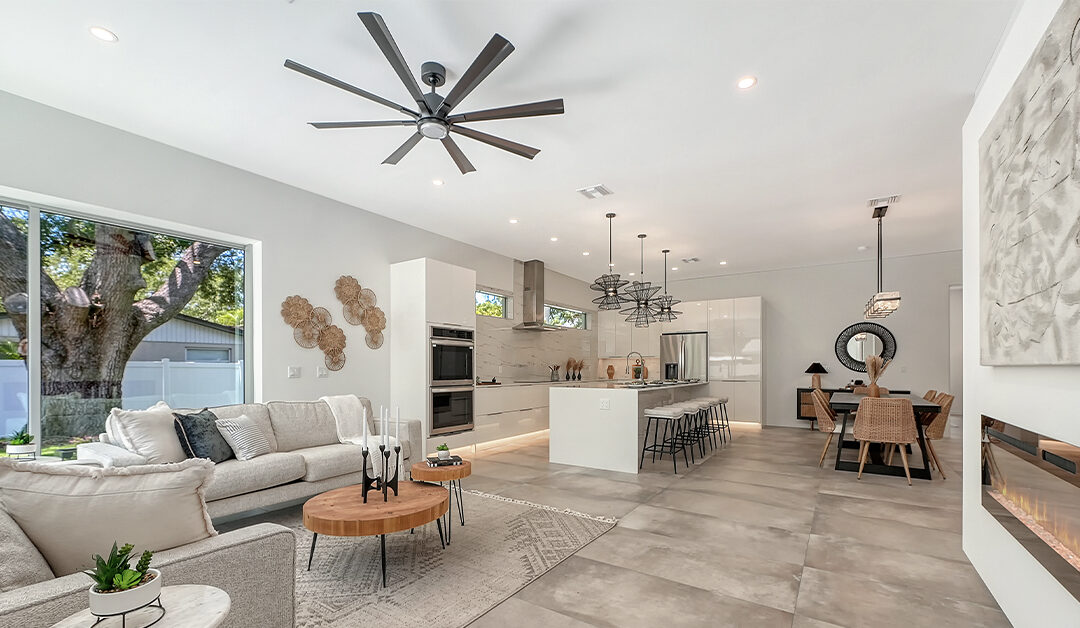
Buyers decide fast — often within seconds of walking through a door. Whether you’re selling a custom home or a production build, how a space feels the moment someone enters it matters more than almost any other factor. Staging isn’t about hiding flaws. It’s about helping buyers immediately imagine their life inside the walls.
Presentation Turns Interest Into Offers
When a buyer walks through the door, first impressions aren’t just important — they’re often final. The way a space is presented can be the difference between a lingering walkthrough and a quick exit. Strategic staging bridges the gap between a property’s potential and a buyer’s ability to see themselves living there.
How to Highlight Light, Lines, and Flow
Modern architecture tends to lead with structure — clean lines, open plans, walls of glass. The goal when staging is to step back and let those features do the talking.
Start with light. Pull back every curtain. Remove heavy valances. If a window faces a cluttered side yard, consider a sheer panel that softens the view without blocking the sun. Natural light is the one thing no photograph can fake convincingly, so make sure it reads in every room.
Then think about flow. Walk the path a buyer will naturally take from the front door through the main living areas. Is anything interrupting it? A chair pushed too far out, a rug that cuts the room awkwardly, an extra console table that made sense for daily life but reads as clutter on a showing day — remove it. You want the eye to travel forward, not snag.
Lines matter too. In a room with strong architectural detail — exposed beams, a floating staircase, floor-to-ceiling cabinetry — keep furniture low and minimal. Let the structure be the focal point. One oversized sofa and a single coffee table will often do more for a space than a full furniture arrangement.
Why Neutral Layers Let Architecture Speak
There’s a reason every serious stager defaults to a neutral palette: it works. Not because neutral is boring, but because it removes the buyer’s mental labor. They’re not thinking “I’d have to repaint that.” They’re thinking “I could see myself here.”
That said, neutral doesn’t mean flat. The goal is layered tone — warm whites, soft linens, muted stone, natural wood. Think of it like a well-edited outfit: each piece is understated, but together they read as intentional.
In a modern home, the architecture itself provides contrast. A polished concrete floor, a dark steel window frame, an arched doorway — these are your visual anchors. Staging in neutral tones keeps those elements prominent instead of competing with them.
Avoid the temptation to add personality through bold accessories. A single sculptural vase or a stack of well-chosen books on a coffee table is plenty. The moment a buyer starts noticing your stuff, they stop seeing the home.
The Small Upgrades That Photograph Beautifully
Listing photos are the first showing. Most buyers will tour a home online before they ever schedule a visit, which means certain small upgrades carry outsized weight.
Swap out dated hardware. Cabinet pulls, door handles, and bathroom fixtures are inexpensive to replace and immediately register as either current or tired. Brushed brass, matte black, and satin nickel all read as modern and photograph cleanly.
Replace any bulbs that cast yellow or uneven light. Consistent, warm-white lighting throughout a space makes photos look cohesive rather than patchy — and buyers notice the difference even if they can’t name it.
Add a single intentional moment in each room: a tray with a candle and a small plant in the kitchen, a folded throw on a reading chair, fresh white towels in the bathroom. These aren’t decorating decisions — they’re camera cues. They give the photographer something to anchor on, and they signal to buyers that the home has been cared for.
Finally, don’t underestimate the front exterior. A power-washed driveway, fresh mulch, and two matching planters at the entry can be the difference between a buyer clicking through your listing or scrolling past it.
Frequently Asked Questions
Do I need to hire a professional stager?
Not always. If your home already has strong bones and clean finishes, a good edit — removing excess furniture, neutralizing bold colors, deep cleaning — can accomplish most of what a stager would do. Where professional staging earns its fee is in vacant homes, where empty rooms make it genuinely hard for buyers to understand scale and function. For more guidance on staging strategies, there are plenty of resources worth reviewing before deciding which route to take.
How much should I spend on staging?
A common guideline is 1–3% of the listing price, but that’s a ceiling, not a target. Prioritize the main living area, primary bedroom, and kitchen. Those three spaces drive the most buyer decisions and the best listing photos.
Does staging actually affect sale price?
The data says yes. The National Association of Realtors reports that staged homes sell faster and, in many cases, for more money than comparable unstaged properties. But the more direct answer is this: staging reduces the buyer’s mental friction. The easier it is to imagine living somewhere, the stronger the emotional pull — and emotion is what drives offers.